Pricing Heuristics Against Non-human Transaction Orchestration Mechanisms
Abstract
PHANTOM formalizes a mechanism failure in dynamic pricing under non-human transaction orchestration. LLM-based agents can run reconnaissance in isolated sessions and execute purchases in clean sessions, reducing the platform's ability to extract the Cost of Information (COI), the premium usually generated by demand signal expression.
The project combines behavioral modeling and robust control. We built a controlled e-commerce platform (hotel and airline modes), logged full interaction trajectories and price exposures, learned separable human/agent transition kernels, and used those signals to train contamination-aware pricing policies with a distributionally robust reinforcement learning objective.
Project Scope
The current thesis revision extends both theory and implementation. The main research question is how a pricing system can preserve margin integrity when browsing and purchasing are increasingly orchestrated by AI agents.
- Formal contribution: a Cost of Information erosion theorem showing why price-query saturation can collapse dynamic pricing power.
- System contribution: a hybrid online/offline stack (Next.js storefront, pricing provider, Kafka event streams, Airflow ETL, Redis serving layer).
- Modeling contribution: class-specific transition kernels for human and agent behavior, with KL-divergence based separability scores.
- Control contribution: a contamination-aware DR-RL pricing policy trained under distributional uncertainty using Wasserstein-style robustness.
Controlled trials currently include balanced human and agent sessions with goal-driven tasks across hotel and airline interfaces. Early separability results are strong (Mann-Whitney U=2.0, p=0.0006), while robust pricing gains remain regime-dependent and are being calibrated in larger sweeps.

Early simulator traces showing how policy choice can push prices toward aggressive high-end regimes.

Human and agent behavior diverge at the transition-kernel level, enabling usable session-level separability.

End-to-end architecture linking web interactions, pricing queries, event streams, and model updates.

Contamination-aware evaluation compares robust and non-robust pricing behavior across alpha sweeps.
Defense Scenes
COI from first principles.
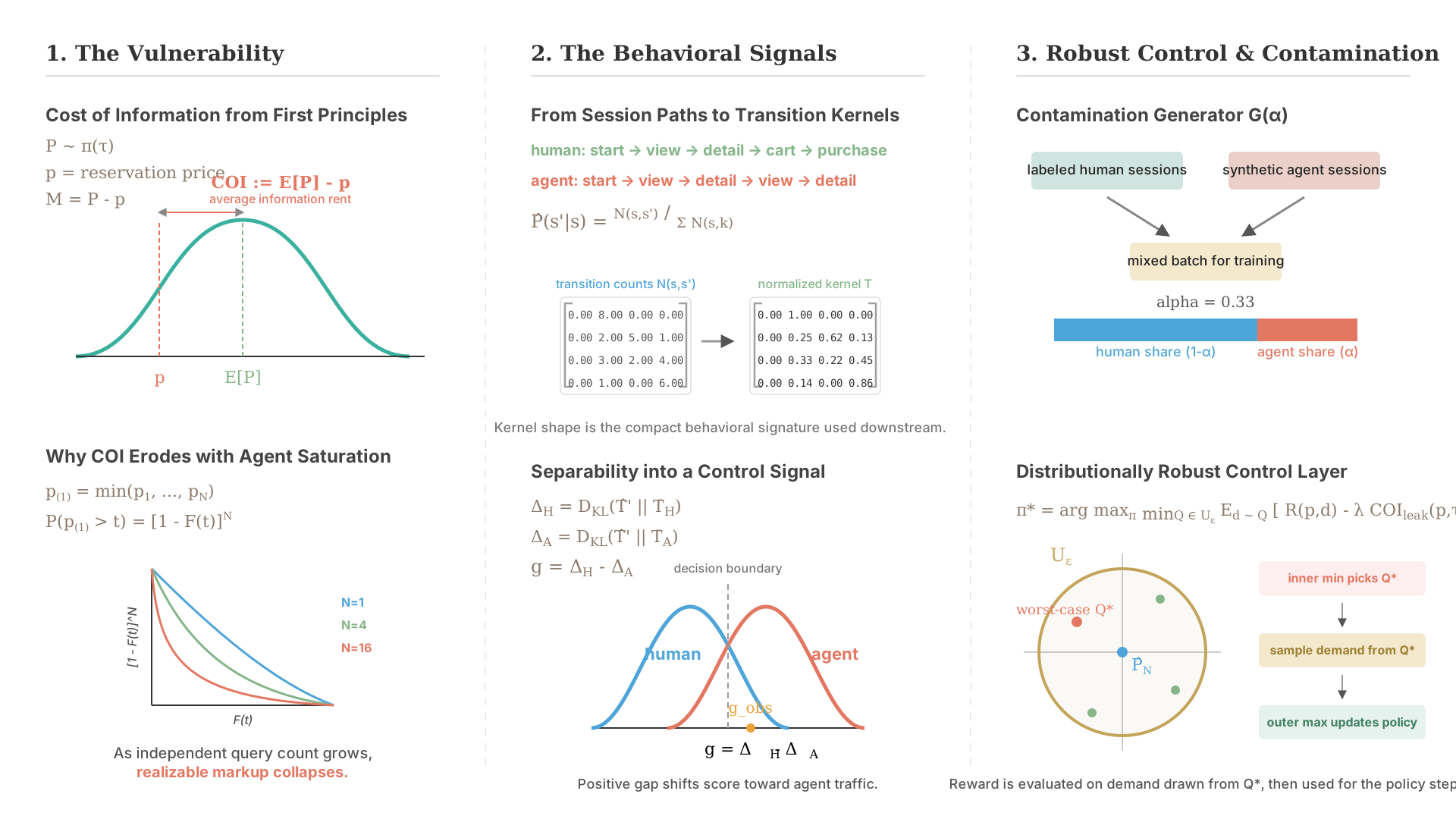
Unified teaser: vulnerability, behavioral kernels, and robust control loop.
Distributionally robust control loop.
Full Thesis
BibTeX
@thesis{Rosel2025PHANTOM,
  title={Pricing Heuristics Against Non-human Transaction Orchestration Mechanisms},
  author={Rösel, Daniel},
  school={IE University},
  year={2025},
  address={Madrid, Spain},
  type={Bachelor's Thesis},
  note={Advisor: Alberto Mart{\'i}n Izquierdo}
}